What are Incoterms®?
Incoterms® are globally recognized trade rules published by the International Chamber of Commerce (ICC). They define the obligations of buyers and sellers in international trade by clarifying:
- Responsibility for transportation costs;
- Transfer of risk in shipping;
- Export and import customs clearance;
- Cargo insurance requirements.
Incoterms® are a fundamental part of international shipping, freight forwarding, logistics, import, and export operations. They do not regulate payment terms or transfer of ownership.
Why Incoterms® Are Important in International Trade?
Using the correct Incoterms®:
- Reduces legal and commercial risk;
- Prevents disputes between buyers and sellers;
- Clarifies logistics and cost responsibilities;
- Improves supply chain transparency.
*Always include the Incoterms® rule, location, and version in contracts, for example: “DAP Munich, Germany – Incoterms® 2020”
EXW (EX Works)
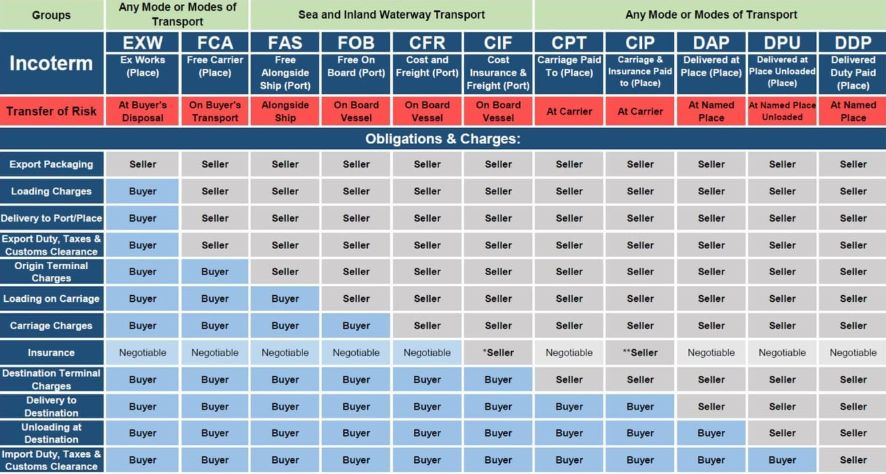
Under EXW Incoterms® 2020, the seller makes the goods available at their premises, such as a factory or warehouse. The buyer bears all transportation costs, risks, export procedures, and customs formalities from that point onward.
EXW places minimum responsibility on the seller and maximum responsibility on the buyer.
FCA (Free Carrier)
With FCA Incoterms® 2020, the seller delivers the goods to a carrier or another party nominated by the buyer. The risk transfers once the goods are handed over to the carrier.
FCA is one of the most commonly used Incoterms® for international and containerized shipments.
CPT (Carriage Paid To)
With CPT Incoterms® 2020, the seller pays for transportation to the agreed destination. The risk transfers when the goods are delivered to the first carrier.
CPT is suitable for all modes of transport, including multimodal shipments.
CIP (Carriage & Insurance Paid)
CIP Incoterms® 2020 require the seller to arrange transportation and cargo insurance. Risk transfers when goods are handed to the first carrier.
CIP requires higher insurance coverage than CIF, making it suitable for high-value goods.
DAT (Delivered at Terminal)
Delivered at Terminal DAT named place Incoterms® 2010 — This term may be used regardless of the mode or modes of carriage to be used.
DAP (Delivered at Place)
Under DAP Incoterms® 2020, the seller delivers the goods to the named destination, ready for unloading. The buyer is responsible for import customs clearance and duties.
DAP is widely used in door-to-door international deliveries.
DDP (Delivered Duty Paid)
With DDP Incoterms® 2020, the seller assumes all costs and risks, including transportation, customs clearance, import duties, and taxes. Goods are delivered ready for unloading at the destination.
DDP offers maximum convenience for the buyer and maximum obligation for the seller.
FAS (Free Alongside Ship)
Under FAS Incoterms® 2020, the seller places the goods alongside the vessel at the named port of shipment. The risk transfers before the goods are loaded onto the ship.
FAS is used mainly in sea freight and bulk cargo shipping.
FOB (Free on Board)
FOB Incoterms® 2020 require the seller to load the goods on board the vessel at the port of shipment. The risk transfers when the goods are on board the ship.
FOB is suitable only for maritime transport and is not recommended for containerized cargo.
CFR (Cost & Freight)
Under CFR Incoterms® 2020, the seller pays the transportation costs to the destination port. The risk transfers when the goods are loaded onto the vessel at the port of shipment.
CFR is widely used in international sea freight and commodity trading.
CIF (Cost Insurance & Freight)
CIF Incoterms® 2020 are similar to CFR but also require the seller to provide minimum cargo insurance. Risk transfers at the port of shipment, not at destination.
CIF is one of the most frequently used Incoterms® in international trade.
DPU (Delivered at Place Unloaded)
DPU Incoterms® 2020 require the seller to deliver and unload the goods at the agreed place. The risk transfers after unloading.
DPU is the only Incoterm® that includes mandatory unloading.